The 13 Different Types of Western Saddles and Their Purpose
Western saddles come in more than a dozen distinct styles, each one built around the demands of a specific job. Choosing the right one starts with knowing what each saddle is designed to do. This guide will walk you through the most common types of western saddles. We will also touch on the parts that define them and how to pick the one that fits your discipline.
Parts of a Western Saddle
Before comparing the types of western saddles, it helps to know the main parts. Each component influences how the saddle fits your horse, supports your rider position, and performs in different disciplines.
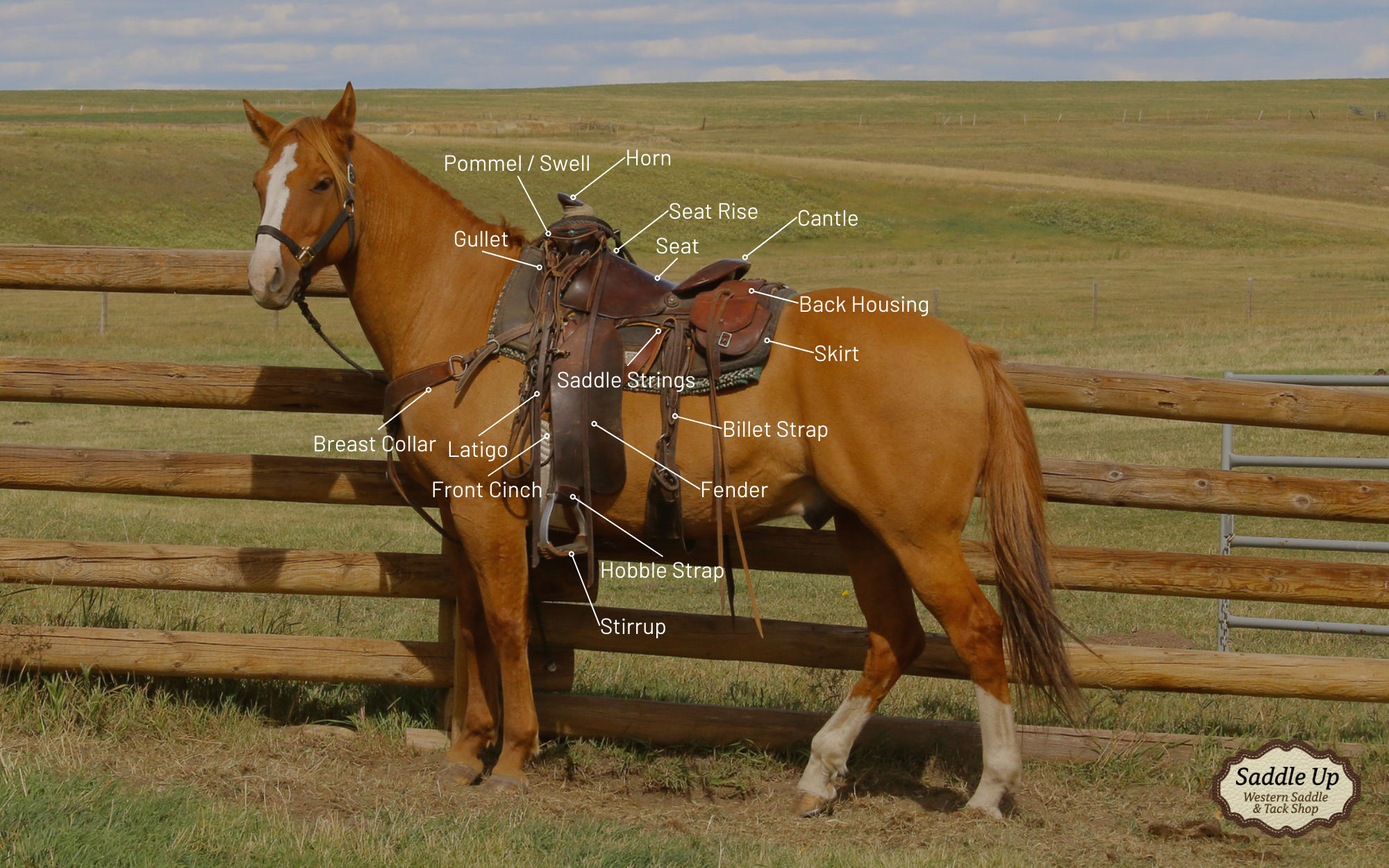
- Saddle Horn- Positioned at the front, it is used for gripping or dallying a rope. Shape varies- a tall horn or thin horn for quick events, or a reinforced version for a roping saddle.
- Pommel / Swell- The raised front section that forms the base of the horn, adding stability and helping the rider stay centered.
- Seat Rise- Slight incline behind the pommel that positions the rider toward the back for better balance.
- Seat- The main sitting area. Depth depends on the discipline- a deep seat pairs well with a high cantle for security, while a flatter seat with a low cantle offers more freedom.
- Cantle- The back edge of the seat that supports the rider's position. Higher cantle designs offer more back support, while lower cantle styles allow easier movement.
- Skirt- Leather panels under the seat that give your saddle its style or a particular look. Often tooled or decorated for style.
- Back Housing- Reinforces the rear of the saddle.
- Gullet- The open space above the horse's back that clears the withers and spine- width affects saddle fit.
- Front Cinch- Keeps the saddle anchored in place, referred to as a girth on an English saddle.
- Latigo- Long strap used to secure the front cinch through the D-ring- allows for tightening your cinch and making fine adjustments.
- Latigo Strap Holder- Holds excess latigo neatly out of the way.
- Rear or Flank Cinch- Adds stability and prevents the saddle from lifting at the rear. See more in our back-and-flank cinch selection.
- Rear or Flank Billet Strap- Attaches the back cinch to the saddle securely.
- Cinch Hobble- Connects the front and back cinch under the belly to keep the back cinch from sliding too far back and becoming a bucking strap.
- Fenders- Wide leather panels that connect the stirrups to the saddle and protect the rider's legs.
- Stirrups- Support the rider's feet- slim stirrups are favored in barrel racing for quick repositioning, whereas Roper stirrups have a wider tread for balance in posting to rope.
- Hobble Strap- Keeps stirrups in alignment at the base of the fenders.
- Saddle Strings- Leather ties for attaching gear, essential for long hours in a trail saddle.
- Breast Collar- Helps hold the saddle forward on steep climbs or when pulling weight.
- Unique Features- Decorative silver, tooling, or a different shape skirt can add function and style.
A Quick Note on Saddle Trees
The tree is the rigid skeleton underneath the leather. It shapes the saddle and determines how it sits on the horse. Trees go by several names, and each one matters when you are comparing types of western saddles-
- Wade tree- A slick-fork design with a thick, low wood-post horn. The signature tree of Wade saddles, popularized by horse riders like Tom Dorrance, Ray Hunt, and Buck Brannaman.
- Association tree- A swelled-fork tree with a metal horn. The standard for many traditional ranch and roping saddles.
- Modified Association- A lighter, slimmer variant of the Association tree, common in modern ranch saddles.
- Flex tree- Built with rigid fork and cantle but flexible bars.
- Treeless- No rigid skeleton at all- relies on padding and the horse's natural shape.
Common Types of Western Saddles
1. All-Around Saddle
An all-around saddle is built for versatility, making it a favorite for riders who do a little of everything. It's sturdy enough for light roping, balanced enough for speed events, and comfortable for long hours in the saddle. Whether you're working cattle, competing in the arena, or enjoying trail riding, this is a reliable, multi-purpose option.
- Use- Ideal for riders who switch between different riding styles like ranch work, pleasure riding, and local competitions.
- Features- Medium weight, reinforced horn for light roping, balanced cantle height, and a seat that offers both security and freedom of movement.
- What to Consider- Make sure the saddle fit works for both you and your horse's back. A durable tree and solid rigging will handle varied activities without sacrificing comfort.
2. Barrel Saddle
A barrel racing saddle is built for speed, agility, and rider security during sharp turns. Its lighter weight helps the horse accelerate faster, while the deep seat and higher cantle keep you locked in as you round the barrels.
- Use- Designed for barrel racing and other speed-based events where quick turns and fast acceleration are essential.
- Features- Lightweight design, compact skirt, slim stirrups for quick foot movement, tall horn for grip, and close contact feel for precise leg cues.
- What to Consider- A quality barrel saddle should fit snugly to prevent slipping at high speeds. It's not intended for roping, as the horn isn't built for that level of strain.
3. Cutting Saddle
A cutting saddle allows the rider to stay balanced while giving the horse full freedom to move quickly and change direction. With a flatter seat and low cantle, it keeps you out of the way while working cattle.
- Use- Built for cutting competitions, team penning, and sorting.
- Features- Low cantle, tall horn, high pommel, and long skirts. The seat is flat with a slight rise near the pommel for balance and close contact with the horse.
- What to Consider- Since a cutting saddle is not meant for roping, it focuses on comfort, balance, and versatility for precise cattle work.
4. Endurance Saddle
An endurance saddle is built for very long rides. Competitive endurance events can cover 50 to 100 miles in a day across rough, varied terrain. The defining feature is its lightweight design, with a short skirt, padded seat, and many saddle strings for securing essential gear. Most endurance saddles have no horn. Many trail riders also choose endurance saddles for their comfort and low weight.
- Use- Competitive endurance riding, ultra-long trail rides, and any discipline where comfort over many hours matters more than horn-based utility.
- Features- Padded seat, lightweight construction (often 18 to 25 pounds), short or rounded skirt, no horn, center fire rigging, multiple saddle strings and D-rings for gear, and a deep but freedom-of-movement-friendly seat shape.
- What to Consider- Because there is no horn, an endurance saddle is not the right choice for every rider.
5. Mounted Shooting Saddle
A mounted shooting saddle is designed for speed and maneuverability, with features that make it easier for the rider to switch firearms during competition. Lightweight and streamlined, it offers a deep seat for stability while still allowing quick dismounts.
- Use- Best for cowboy mounted shooting events where agility and firearm handling are priorities.
- Features- Smaller horn, forward-tilted swells, free-swinging fenders, and a close contact skirt for responsive leg cues.
- What to Consider- Not intended for roping. Prioritize balance and clearance so your gear and movement aren't obstructed during competition.
6. Pleasure Saddle
A western pleasure saddle is built for the show ring. It is specifically for western pleasure classes where the horse is judged on movement, temperment and performance. The saddle helps the rider sit quietly and squarely. Pleasure saddles look similar to show saddles but are typically less ornate and more focused on practical rider position. Many riders also use them for relaxed pleasure riding outside the show ring, which is where the name comes from.
- Use- Western pleasure show classes, pattern classes like horsemanship and showmanship, and casual pleasure riding for riders who want a balanced, refined seat.
- Features- Moderate-depth seat, balanced cantle height, refined tooling and silver accents that are less elaborate than a full show saddle, low to medium horn, and a tree that prioritizes rider position over rugged utility.
- What to Consider- A pleasure saddle is not designed for roping or hard cattle work.
7. Ranch Saddle
A ranch saddle is built for heavy-duty, everyday use. Designed for long hours in the saddle, it's a workhorse for everything from dragging logs to roping cattle.
- Use- Best for all-day ranch work and handling livestock.
- Features- Stout horn for roping, strong tree, saddle strings for carrying gear, back cinch, and often has a high cantle for security.
- What to Consider- Ranch saddles are heavy, typically 35 to 50 pounds, so make sure both you and your horse are comfortable with the weight. A Wade has a slick fork and lower wood post horn,
8. Ranch Cutting Saddle
A ranch cutting saddle blends the agility of a cutting saddle with the durability of a ranch saddle. It's designed for cattle work but tough enough to handle roping and ranch work.
- Use- Suitable for both cutting competitions and day-to-day cattle handling.
- Features- Sturdy tree, back cinch, thicker horn for roping, long skirts, and a flat seat with a slight rise near the pommel.
- What to Consider- This is a heavier saddle, so check the weight against your needs. While it is strong enough for roping, it is more commonly used for ranch roping than team roping.
9. Reining Saddle
A reining saddle is designed for precision. It gives the rider the ability to deliver subtle cues while staying balanced through spins, slides, and stops.
- Use- Specifically for reining competitions and training.
- Features- Lower horn, moderate cantle height, flatter seat for hip movement, and close contact skirts to enhance communication with the horse.
- What to Consider- Since a reining saddle isn't meant for roping, focus on fit, balance, and a seat that allows freedom of leg movement for performance maneuvers.
10. Roping Saddle
A roping saddle is built for strength, stability, and safety. Its reinforced horn and heavy-duty tree can handle the strain of roping and dallying without compromising the saddle.
- Use- Designed for team roping, calf roping, and ranch work involving cattle.
- Features- Thick horn, strong tree, flank cinch, lower cantle for easier dismounts, and heavy rigging for durability.
What to Consider- These saddles are heavier than most, so consider your horse's stamina and your own handling needs.
11. Show Saddle
A show saddle combines function with presentation. It's built to position the rider in perfect equitation form while showcasing ornate craftsmanship that stands out in the arena.
- Use- Best for western pleasure classes, showmanship, and competitions where appearance is judged.
- Features- Decorative silver, intricate tooling, long skirts, and a seat designed for balance. Usually has a different shape skirt and unique features to catch the eye.
- What to Consider- Show saddles are heavier and can be more expensive than other styles. Entry-level show saddles start around $1,500 and custom show saddles can exceed $10,000 due to the silver work and hand tooling. The distinction between a show saddle, an equitation saddle, and a pleasure saddle is mostly about how much decoration is on the leather and how flat the seat is. The underlying tree and rigging are similar.
12. Trail Saddle
A trail saddle is built for hours in the saddle on varied terrain. Compared to a pleasure or endurance saddle, the trail saddle prioritizes a balance of comfort and gear capacity. It also commonly features a padded or gel seat and plenty of saddle strings for tying on bags and gear.
- Use- Recreational trail riding, multi-hour day rides, pack-supported trips, and any discipline that demands all-day rider and horse comfort.
- Features- Padded or gel seat (though some experienced trail riders prefer a hard seat for long distances), moderate to high cantle, short skirts, abundant saddle strings, breast-collar compatibility, and light weight
- What to Consider- Lightweight materials and proper saddle fit matter more on a trail saddle than on almost any other type, because the horse will wear it for many hours. A barrel saddle can substitute on trail rides.
13. Wade Saddle
The Wade saddle is the working cowboy's favorite. It is a slick-fork, no-swell design built on a Wade tree. It also has a thick, low-set wood-post horn. It was popularized by California buckaroos and made famous in modern horsemanship circles by Tom Dorrance, Ray Hunt, and Buck Brannaman. The low horn position puts less torque on the horse during heavy roping, and the slick fork lets the rider sit deeper and more connected to the horse than a swelled-fork saddle allows.
- Use- All-day ranch work, heavy roping, dallying cattle, and any discipline where horse comfort and rider feel over many hours matter most. Increasingly popular among trail riders and clinicians who value its versatile, traditional design.
- Features- Slick fork with no swells, low wood-post horn (typically wrapped with a horn cover for grip), deep seat, high cantle,
- What to Consider- Without swells to hook your thighs against, the Wade saddle takes some getting used to. The seat is what holds you in. Wade saddles tend to be heavier (35 to 45 pounds is common) A lighter version would be a Lady Wade.
Western Saddle vs English Saddle- A Side-by-Side Comparison
Western and English saddles are the two main families of saddles, and they are built around very different riding traditions. A western saddle distributes the rider's weight over a larger surface area, features a horn at the front, and is built for stability during long working rides or in active disciplines like roping. An English saddle is lighter, has no horn, and places the rider closer to the horse for the precise leg cues required in jumping, dressage, and eventing.
|
Feature |
Western Saddle |
English Saddle |
|
Typical weight |
25 to 50 pounds |
10 to 20 pounds |
|
Horn |
Yes. Used for roping, balance, gripping |
No horn |
|
Seat |
Deep, often with high cantle for security on long or fast rides |
Flatter and closer to the horse for precise leg position |
|
Stirrups |
Wide tread, connected via fenders |
Narrow, hung from thin leathers for close leg contact |
|
Cinch / girth |
Cinch. Typically with a separate flank cinch on working saddles |
Girth. Single, typically with billets and buckles |
|
Primary disciplines |
Ranch work, roping, barrel racing, cutting, reining, trail riding, mounted shooting, western pleasure, western dressage |
Dressage, show jumping, eventing, hunter classes, polo, sidesaddle |
|
Rider feel |
Secure, deep, stable. Built for hours of work or sustained discipline-specific demand. |
Close, sensitive, athletic. Built for precise communication with the horse. |
Choosing the Perfect Saddle
Your saddle choice depends on your riding discipline, saddle fit, and the comfort needs of both horse and rider.
- Match the cantle style (low cantle, higher cantle, or high cantle) to your support preference.
- Select the horn style (tall horn, thin horn, or lower horn) for your activity.
- Factor in weight, durability, and whether you'll use back or flank cinch for added support and stability.
- Choose trusted brands for a dependable build, but always start with fit for the horse.
- Choose your correct seat size.
- Decide new versus used. A quality used saddle from a reputable maker holds value and often rides better than a brand-new entry-level saddle.
Best Western Saddle for Beginners- A Decision Framework
Beginner riders ask one question more than any other- what is the best western saddle to start with? The honest answer is that there is no single best saddle. There is a best saddle for your discipline, your horse, and your budget. Here is a quick framework to narrow the choice.
|
If you mostly plan to... |
Start with this saddle type |
Why |
|
Ride trails or do casual pleasure riding |
Trail saddle, Barrel Saddle, or All-Around saddle |
Security, Comfort, and a balanced seat.. |
|
Work cattle on a ranch or small farm |
Ranch saddle or All-Around saddle |
Durable enough for daily use. The horn can handle roping while you learn. |
|
Try several disciplines before committing |
All-Around saddle |
Built to handle a bit of everything- light roping, speed events, trail, arena work. |
|
Compete in barrel racing or gymkhana |
Barrel saddle |
Deep seat and high cantle keep beginners secure on tight, fast turns. |
|
Show in western pleasure or equitation |
Pleasure saddle (entry-level) |
Refined position and balanced seat for show ring posture without the cost of full silver. |
A few more rules of thumb for a first western saddle-
- Get the fit checked first. Saddle fit for the horse matters more than any feature on the saddle itself. Take advantage of our saddle fit guide before buying.
- Seat size matters
- If a seat is too small for the rider, it will pitch you forward
- If a seat size is too big for the rider, your feet will be in front of you not underneath of you
- A quality used saddle from a reputable maker can be a great investment for a beginner. Browse our used saddles.
Ride with Confidence
Understanding the types of western saddles makes it easier to find the perfect saddle for your riding style. Each saddle's design has its own strengths, features, and considerations. The right choice comes down to matching the saddle's purpose with your needs, ensuring proper saddle fit, and selecting quality craftsmanship that will last for years.
At Saddle Up Colorado, we know that finding the right saddle is about performance, durability, and a great fit. Our team can help you browse through different options, answer your questions, and guide you toward the saddle that's built for your kind of riding. Whether you're chasing seconds in barrel racing, tackling all-day ranch work, or enjoying long hours on the trail, we're here to make sure you ride with confidence.
Frequently Asked Questions
1. What's the difference between a western saddle and an English saddle?
A western saddle distributes the rider's weight over a larger surface area, features a horn at the front, and is built for stability during long working rides or in active disciplines like roping. An English saddle is lighter (typically 10 to 20 pounds versus 25 to 50 pounds for a western), has no horn, and places the rider closer to the horse for the precise leg cues required in jumping, dressage, and eventing. See our full side-by-side comparison above.
2. Which type of western saddle is best for beginners?
For most beginners, an All-Around saddle or Trail saddle is the best starting point. Both offer a deep, secure seat, a forgiving horn for grip, and balanced rigging that works across multiple disciplines. If you know you will focus on a specific discipline (barrel racing, ranch work, showing), choose a saddle built for that discipline. See our beginner decision framework above for a tailored recommendation.
3. What makes a barrel racing saddle different from a trail saddle?
A barrel racing saddle is lighter (typically under 25 pounds), has a deep seat with a high cantle, slim stirrups, and a tall thin horn for grip during sharp turns at speed. A trail saddle prioritizes long-ride comfort with a padded seat, balanced cantle, wider stirrup tread, and abundant saddle strings for gear. A barrel saddle can be used on short trails, but some trail riders do not like the tall saddle horn on a barrel.
4. Can one saddle work for multiple disciplines?
Yes. The All-Around saddle is designed for riders who switch between disciplines such as trail, ranch work, and arena events. However, each specialized saddle (barrel, cutting, reining, roping, Wade, show) is built for its discipline and will outperform an All-Around saddle in that specific use.
5. What is a Wade saddle?
A Wade saddle is a working ranch and roping saddle built on a Wade tree, which is a slick-fork design with no swells and a thick, low-set wood-post horn. It was popularized by California buckaroos and made widely known through horsemen like Tom Dorrance, Ray Hunt, and Buck Brannaman. The low horn puts less torque on the horse when dallying, and the slick fork lets the rider sit deeper and feel more connected to the horse.
6. What is a Wade saddle used for?
Wade saddles are used for all-day ranch work, heavy roping and dallying, and increasingly for trail riding by riders who value the deep seat and traditional design. They are not built for speed events like barrel racing or for arena disciplines like reining or cutting where a swelled fork is preferred.
7. What is the difference between a Wade saddle and a ranch saddle?
A Wade saddle is technically a type of ranch saddle, but the term Wade specifically refers to a saddle built on a Wade tree- slick fork, no swells, thick wood horn. A general ranch saddle is more often built on an Association or Modified Association tree, with moderate swells and a sturdier metal horn. Wade saddles tend to feel deeper and more connected. Standard ranch saddles tend to feel more conventional with swells to brace against.
8. What is a saddle horn used for?
The saddle horn has three main uses- dallying a rope (wrapping it around the horn) when working cattle, providing a grip point for the rider during sharp turns or unexpected horse movements, and serving as a tie point for tools or gear. The horn's size and material vary by saddle type. A roping saddle has a tall, thick, reinforced horn, while a barrel saddle has a tall, thin horn for grip only.
9. What's the difference between a saddle pommel and a saddle horn?
The pommel and horn are two distinct parts of the saddle, even though riders often use the words interchangeably. The pommel is the raised front section of the saddle, which forms the base over the horse's withers. The horn is the upright knob that sits on top of the pommel. The pommel is structural. The horn is functional (used for roping and grip).
10. What is a cantle?
The cantle is the raised back edge of the saddle seat. A higher cantle provides more back support and security, which matters in barrel racing and ranch work. A lower cantle offers more freedom of movement and easier dismounts, which matters in cutting, roping, and reining.
11. How much does a western saddle weigh?
Western saddles typically weigh between 25 and 60 pounds depending on the type. Lightweight options include barrel saddles (15-25 pounds) and endurance saddles (18-25 pounds). Mid-weight saddles include reining and pleasure saddles (25 to 35 pounds). Heavy-duty saddles include ranch, roping, and Wade saddles (35 to 50 pounds), with custom show saddles sometimes exceeding 50 pounds due to silver work.
12. How many types of western saddles are there?
There are 13 commonly recognized types of western saddles covered in this guide- All-Around, Barrel, Cutting, Endurance, Mounted Shooting, Pleasure, Ranch, Ranch Cutting, Reining, Roping, Show, Trail, and Wade. Specialty subtypes exist within several of these categories (for example Lady Wade, ranch cutter, and association ranch saddles).
13. Can you use a barrel saddle for trail riding?
You can use a barrel saddle for short trail rides, but it is not ideal for long days in the saddle. Barrel saddles are designed for short, intense runs. They have small, hard seats, slim stirrups, and limited saddle strings for carrying gear. Many trail riders do not prefer the taller saddle horn when riding in various terrain. For trail rides longer than an hour or two, a trail saddle, endurance saddle, or All-Around saddle will be more comfortable for both you and your horse.
14. What is an association saddle?
An association saddle is a traditional ranch and roping saddle built on an Association tree, a swelled-fork design with a sturdy metal horn and standardized dimensions originally set by the rodeo associations of the early 1900s. The Modified Association is a slimmer, lighter variant that has become common in modern ranch saddles. Association saddles offer a balanced compromise between the deep ride of a Wade and the arena focus of a roping saddle.
15. What's the difference between a roping saddle and a ranch saddle?
A roping saddle is built specifically for the demands of competitive roping- heavy double rigging, a thick reinforced horn, and a low cantle for easier dismounts. A ranch saddle is built for all-day general work, with a sturdy horn that can rope but is also comfortable for hours of riding, plus saddle strings for gear and often a higher cantle for back support. If you mostly rope in the arena, choose a roping saddle. If you mostly work cattle on a ranch and rope occasionally, choose a ranch saddle.
16. What's the difference between a cutting saddle and a ranch cutter?
A cutting saddle is built strictly for cutting competition- flat seat, low cantle, tall horn for grip (not roping), and free-swinging fenders for cattle-tracking communication. A ranch cutter is a hybrid. It has the agility and seat shape of a cutting saddle but a sturdier tree and thicker horn, so it can also handle ranch work and light roping. If you compete only in cutting, choose a cutting saddle. If you work cattle and want one saddle that does both, choose a ranch cutter.
17. What is an equitation saddle?
An equitation saddle is a show-ring saddle designed to help the rider maintain perfect posture and leg position for equitation classes, where the rider's form is judged. It overlaps significantly with both show saddles and pleasure saddles. The seat is balanced, the cantle is moderate, and the horn is typically low. The decoration is usually less elaborate than a full show saddle, focused on rider position rather than visual impact.
Leave a Comment