Saddle Pads, What to Use? Choosing the Right Western Saddle Pad for You and Your Horse
Posted by Zoey Snyder on Feb 9th 2026
Choosing the Right Western Saddle Pad for You and Your Horse
When it comes to western saddle pads, it’s tempting to look for a single “best” option, the one pad that will solve pressure points, improve comfort, and work for every horse and saddle combination. The reality, however, is that selecting the right saddle pad is a highly situational process. Factors such as saddle fit, horse conformation, riding discipline, and even personal preference all play a role. While we would love to recommend one perfect saddle pad for everyone, our goal instead is to help you understand how to choose the best saddle pad for you and your horse. A well-informed choice will always outperform a one-size-fits-all recommendation.
Common Misconceptions About Saddle Pads
One of the most common misconceptions in the western riding industry is the belief that a saddle pad can fix an ill-fitting saddle. While saddle pads can help fine-tune fit, improve comfort, and protect your horse’s back, they cannot be used to compensate for a saddle that simply does not fit. Another common misconception is that a thicker saddle pad is better; this is not always the case. Adding thicker pads, stacking liners, or switching materials in an attempt to “make it work” often creates more problems than it solves, including uneven pressure, restricted movement, and soreness. A saddle pad should complement a well-fitting saddle, not mask fundamental issues. If your saddle consistently bridges, pinches, or you notice soreness/behavior changes, the solution starts with addressing saddle fit before looking to the pad underneath it. If you are a Colorado local, schedule a saddle fit with us here. If you are out of state or not able to travel, check out our back tracing program here.
Saddle Fit Comes First
Having a well-fitting saddle makes the saddle pad selection process significantly easier. When a saddle fits properly, weight is distributed evenly across the horse’s back, allowing the pad to do its job: cushioning, moisture management, and protection. In these situations, saddle pads should function similarly regardless of brand or style, assuming comparable thickness and materials. The pad becomes a supportive layer rather than a corrective tool. If you find yourself constantly changing pads to chase comfort issues, it’s often a sign that the saddle fit itself needs to be reevaluated. A properly fitted saddle paired with an appropriate pad creates a stable foundation for both horse and rider.
Conformational Considerations
No two horses are built the same, and conformation plays a major role in saddle pad choice. Back shape, wither height, shoulder angle, and overall musculature all affect how a saddle and pad interact. Some horses have prominent withers and a dipped topline, while others are wide, flat, and muscular with minimal wither definition. These differences influence how a pad should be shaped and structured to avoid pressure points and movement. Understanding your horse’s conformation helps narrow down pad styles that are more likely to work comfortably over time.
At one end of the spectrum, sway-backed horses tend to have a noticeable dip behind the withers. These horses often benefit from pads that offer even contact without excessive bulk in the center, as over-padding can worsen bridging. At the opposite extreme are barrel-backed horses, which are broad, flat, and round through the ribcage. These horses may experience saddle roll and often do better with contoured pads that help the saddle stay centered. Most horses fall somewhere between these extremes, but recognizing where your horse lands helps guide smarter pad choices.
Discipline Considerations
Your riding discipline also influences which western saddle pad will work best. Ranch riding, roping, reining, trail riding, and showing all place different demands on a pad. Riders who spend long hours in the saddle may prioritize breathability and moisture control, while performance riders may need shock absorption and stability during quick maneuvers. Riders who compete in showing often balance function with appearance, selecting pads that meet discipline standards while still protecting their horse. While the fundamentals of pad fit remain consistent, how you ride matters when choosing materials, thickness, and style. Generally, medium pads (3/4" to 7/8") offer versatility for daily training and general riding. A thicker saddle pad may assist with shock absorption, while a thinner pad may be helpful when keeping saddle fit in consideration. Here are a few discipline-specific examples:
Reining
- Contoured wool felt saddle pads are commonly used to provide close contact and effective shock absorption for precise maneuvers such as spins and sliding stops, with a thinner profile that allows clear communication between horse and rider.
Cutting
- High-quality wool felt pads are favored for their ability to evenly distribute pressure and wick moisture, helping horses stay comfortable and mobile during quick lateral movements and intense cow work.
Barrel Racing
- Lightweight, contoured saddle pads made from wool blends or performance foam materials are popular for their shock absorption, spinal clearance, and secure fit during fast acceleration and tight turns.
Western Pleasure
- Riders typically use thinner square show pads or decorative top pads layered over a slim liner, prioritizing a clean, polished appearance while still offering adequate cushioning for slow, consistent gaits.
Ranch Riding / Ranch Versatility
- Dense wool felt or heavy-duty woven saddle pads are commonly chosen for their durability and practicality, as they are designed to withstand long hours of riding, varied terrain, and working conditions.
Trail Riding
- Thicker, well-cushioned saddle pads with strong breathability and moisture control are preferred to keep horses comfortable over long distances, uneven ground, and changing environmental conditions.
Sizing
Be mindful of your saddle's skirt length, your horse's back width, and the length in relation to one another. These factors will help you to choose the perfect size where the saddle pad does not hit the horse’s hip, but will be long enough for the skirt of the saddle.
32x32: long skirt
30x30: average saddle pad size
28x28: small horse/rounded skirt
Note: first number side to side and the second is front to back of the pad.
Placement
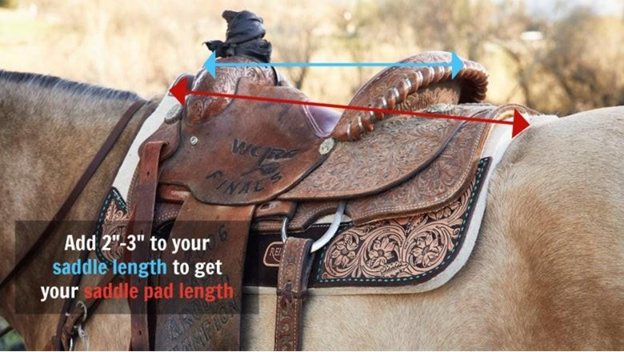
Note: 1-3 inches of saddle pad in the front and in the back of the saddle should be visible
Types of Western Saddle Pads: Pros and Cons
Western saddle pads come in a wide range of shapes, materials, and constructions, each with its own strengths and limitations. Understanding these differences helps you choose a pad that fits your needs rather than following trends or assumptions.
Contoured pads are shaped to follow the natural curve of a horse’s back and are designed to reduce pressure along the spine. They tend to work well for horses with some wither definition and help prevent the pad from bunching under the saddle. Rounded pads, on the other hand, have a more traditional shape and may suit flatter-backed horses, though they can shift more easily on horses with prominent withers.
Wither cutout pads provide additional clearance at the withers and are often helpful for horses with higher or sharper withers. Pads without a cutout rely on proper placement and saddle fit to maintain wither clearance, which can work well for lower-withered or broad horses.
Five-Star pads are known for their dense wool construction, offering durability and consistent weight distribution. They tend to break in over time and mold to the horse’s back, but their density may feel firm initially.
Impact Gel pads focus on shock absorption and can be beneficial for high-impact disciplines, though they may retain heat if not paired with breathable materials.
Diamond Wool pads combine wool felt with thoughtful shaping and are popular for their balance of comfort and longevity.
Mule pads are traditionally thicker and longer, often used for packing or long days in the saddle. While they offer substantial cushioning, they may be excessive for everyday riding with a properly fitted saddle. Toklat pads often incorporate advanced materials designed for airflow and pressure relief, appealing to riders looking for modern performance options.
Toklat pads have a memory foam core that is interchangeable between their styles, each serving a different purpose. A saddle pad with quality impact protection can help you maintain a healthy back and prevent problems long-term.
- Extreme Pro – 10mm XRD™ foam, perforated for breathability. The “yellow” insert is XRD, a foam engineered to absorb 90% of the energy from impact. Extreme Pro is lightweight, highly effective, and ideal for preventive care. Best for: Horses with well-developed topline muscle that should be protected; performance horses in top condition.
- Ortho-Impact – the “blue/yellow” insert is 5mm XRD™ foam bonded to ½” memory foam, perforated for breathability. XRD absorbs 90% of the energy of impact; memory foam cushions the muscles. Ortho-Impact works well for horses that need to build back muscle. Best for: Horses with an undeveloped topline, such as young or green horses; horses that have not been ridden for a while; senior horses with a dropped topline; horses recovering from a back injury or soreness.
- FlexForm – the “blue” insert is ½” memory foam. Memory foam offers cushioning, but little to no impact protection. Best for: adding a little extra cushion for very infrequent and low-impact riding, such as a leisurely pasture ride.
Liners are thinner pads designed to be used underneath a primary pad. They are used to keep your saddle pad clean. While useful in specific situations, liners should not be used to compensate for poor saddle fit. Saddle blankets and blanket hybrids are often chosen for aesthetic reasons, particularly in the show pen, and can be layered with felt pads for added protection.
Showing and Aesthetics
In the show ring, appearance matters, and saddle pads are often selected to complement the horse, saddle, and overall presentation. Show pads may feature decorative tops, wear leathers, or custom designs. While aesthetics are important, function should never be sacrificed. A beautiful pad that causes discomfort will ultimately affect performance. Many modern show pads are designed to balance style and practicality, offering both visual appeal and adequate support. Mayatex pads are sometimes used in addition to a liner or something similar to keep practicality along with appearance.
Saddle Pad Care and Maintenance
Proper saddle pad care extends the life of your investment and protects your horse’s back. Wool and felt pads should be brushed regularly to remove hair and dirt, allowing fibers to breathe and maintain their shape. Pads should be allowed to dry completely between rides to prevent moisture buildup and odor. Periodic deep cleaning, following manufacturer guidelines, helps maintain performance. Inspect pads regularly for uneven wear, compression, or hard spots, as these can create pressure points over time. Here are some tools to assist you in the cleaning process 5 Sar Cleaning Sponge and 5 Star Saddle Pad Cleaner & Soak. Each saddle pad on our website will have specific cleaning instructions, so be sure to check the description before purchasing.
Conclusion
Choosing the right western saddle pad is about understanding the bigger picture rather than chasing a single solution. A well-fitting saddle, thoughtful consideration of your horse’s conformation, awareness of your riding discipline, and knowledge of pad types all work together to guide the decision. While no saddle pad can replace proper saddle fit, the right pad enhances comfort, performance, and longevity for both horse and rider. By approaching saddle pad selection with education and intention, you set yourself (and your horse) up for long-term success in the saddle. If you’re looking for a new saddle pad to meet your needs, shop here.